Over the first few weeks of this course, I have noticed a significant growth in my
academic reading and writing practices, especially in how I preview texts, annotate them,
respond to readings, and integrate sources into my writing. Revisiting my work with American
author Brian Doyle’s “The Hawk” and American author and phycologist Maria Konnikova’s
“The Limits of Friendship” highlights my skills and how they have evolved.
Initially, my annotations we limited to mostly just highlights and underlines here and there. As I
noted in the previous reflection, in high school, I mostly highlighted or underlined the things that
I really didn’t understand, using annotations for a tool for later review rather than deeper
understanding. For example, when reading “The Hawk,” which came first in the two readings, my annotations focused on tone, imagery, and emotional language. This highlighted Doyle’s use of symbolic language to promote community and human connection. This was a powerful move as it was making the reader engage more with the text’s style and emotional essence, rather than just the content itself. As this was our first annotation assignment though, I was still using my high school annotation skills of not nessisarily annotating for understanding but just getting it done so i had the resources for later.
Meanwhile, with Konnikova’s essay, the second set of annotations, my annotations were more analytical. After we talked more about in depth annotations and understanding the text I read it multiple times before I picked up the pen. I highlighted a lot of stats, studies, facts, and examples to track the argumentative structure also while taking note of rhetorical strategies like pathos and logos. This made me understand Konnikovas stance and argument more as the annotations dug into what the writer was trying to say. The contrast between these two articles showed my growing awareness of how different texts need different annotation approaches.
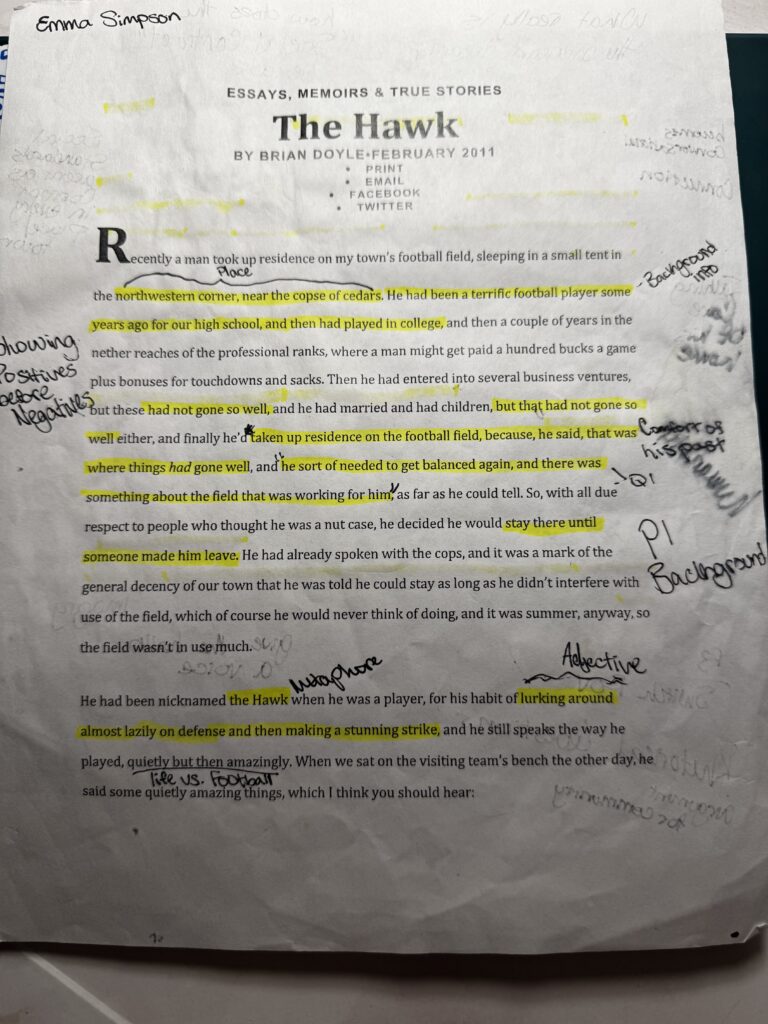
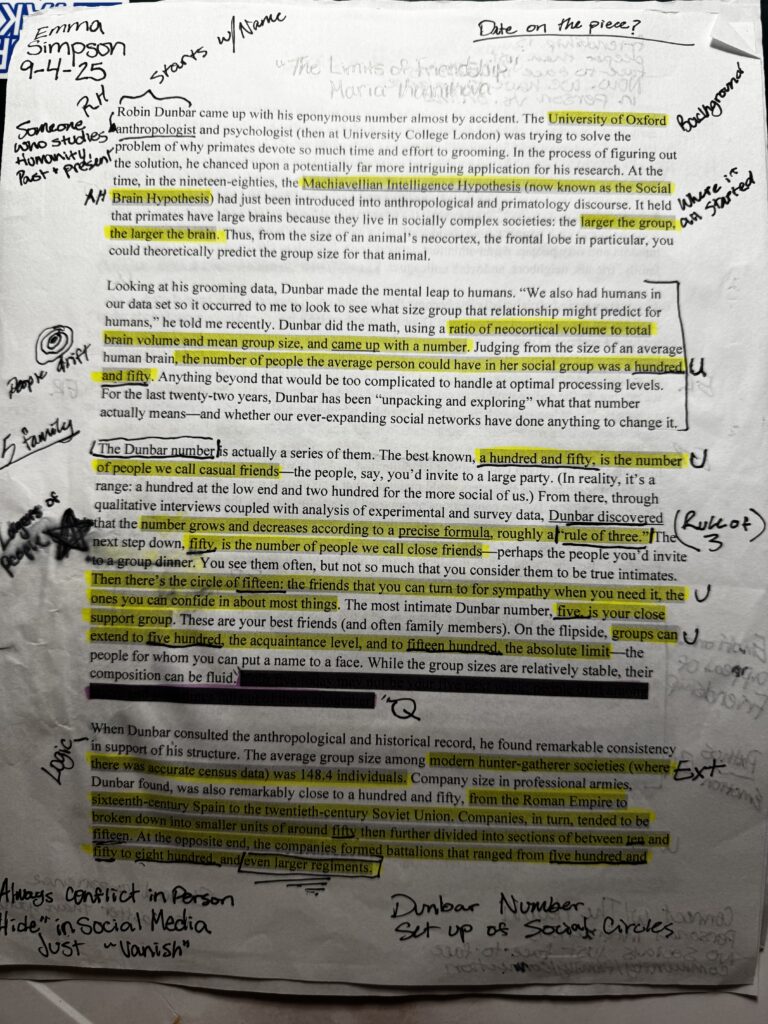
These images show my two different annotations for “The Hawk” and “The Limits of Friendship”. Although they look similar the words arent just random on Konnikovas essay they build understanding they dont just take up room on the page.
Previewing/skimming texts before I fully read them has also become a key part of my writing
process. By scanning headings, key terms, and the overall structure before just diving into the
full reading, I can get understanding and context which helps me as I fully read the text to
enhance my annotations. For example, knowing that “The Limits of Friendship” would include
studies with human beings helped me understand that this wasn’t just an “I believe this is right”
type of text it was one with scientific background. As a highschool student I brefily scimmed texts so I already had a basic understanding of previewing but I never really understood why It was so important that I do it. Now that I preview more it helps me realize there is more to a text than seems if you get deeper into the meaning of the words. Previewing helps you see the depth of the argument or subject before you even give it a full read.
My reading responses have grown from simple summaries to more critical and reflective
responses. In highschool I never really could connect on the larger themes and I would give a really basic and generalized summary on whatever the essay was about. But even in my first response which was “The Hawk”, I connected Doyle’s emotional and symbolic language to the larger themes of human connection and happiness, recognizing the essay/s reflective rather than argumentative tone. In contrast, my response to Konnikova involved synthesizing evidence about social media’s impact on friendships and relating it to emotional and physical touch, which I saw as a key to the essay’s argument. These responses show improved ability to engage with both content and form. Even from my first college reading I was able to contextualize more and retain more information to look at the bigger picture of what point the author was trying to get across.
Regarding source integration, I have begun to practice embedding quotes into my writings more
smoothly. In highschool I would tend to introduce a quote and analyze it but it wouldnt really fit in with the flow of the piece. But with Konnikova’s essay, for example, I can reference specific studies/statistics with explanation and analysis rather than simply dropping quotes into my text. I know how and where to propperly imput a quote and make it smooth. However, I recognize this is an area for continued growth. Sometimes my source integration still feels a bit forced and I want to continue blending sources into my texts while maintaining clarity in the topic. On September 5th, I completed an assignment on who Maria Konnikova is, with this we were also explaining some of her works and ideas. With one of her Ideas of the “Rule of Three” explained what it meant and integrated a quote. The paragraph I wrote was:
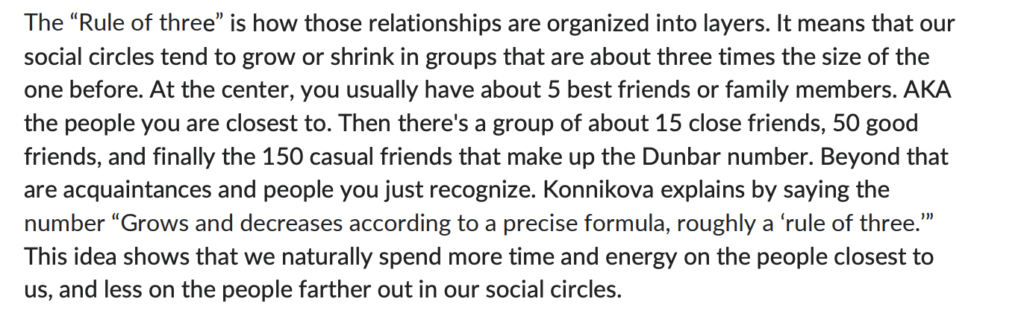
As you can see in the paragraph alone I was randomly imputting a quote and not really analyzing it. It didnt flow with the paragraph overall. Now I would go in approaching it differently. I would analyze and introduce the quote a bit more and tie it back to the overall idea im trying to get across. I also am better now at realizing that you never have to use the full quote, you can partially quote a sentence the author says. Partial quotting is still really strong and gets to the point that you want the readers to see.
In all, my practices with annotation, previewing, reading responses, and source integration have
become more purposeful and strategic. I have moved beyond marking text just to understand it
later to actually comprehending and I’m reading. Moving forward, I aim to develop my source
integration skills further, focusing on incorporation of evidence, and enhancing my analyzations
to deepen my understanding on the topics I am reading. I am nowhere near where I want to be in annotating, source integration, or previewing, it is something that I will continue to work hard on even if I think its “good enough”.

Leave a Reply