Author: Emma Simpson
I say is something more than just made up moments. I say is usually moments that happened in your life that have such an importance that you think of them when thinking of the specific subject. When speaking of my I say in my essay i mention my mom a lot and her words. My mom is a key source of my joy. my mom is my joy. She is my bestfirend and knows everything about me. I know that some think she should because shes my mom, but it goes beyond that. I have thought deeply about when I have felt joy and every time i think ive felt it my mom was always involved or around somehow. I Say doesn’t have to be any importance to anyone other than yourself. In my moms words “something more important than yourself” that is my mom, she is the first person i talk to everyday and if I had one last call i could ever make it would be to her. My joy isnt really found in big events or events in general, it is found in family and mostly my mom.
- In two healthy paragraphs, summarize the speech and show (with framed quotes and paraphrase from the text) what you believe to be the author’s three main points/arguments. Support with textual evidence and include your own initial response to the material.
In is commencement speech This Is Water, David Foster Wallace talks about how we often move through life on “auto pilot” we are all stuck in our own minds and forget about everyone around us. His first main point that I see is that we naturally see everything through our own point of view. He says “everything in my own immediate experiance supports my deep belief that I am the absolute center of the universe” which show how easy it is for us to think that our problems matter the most. His second point is that real education is about learning how to choose what to think about. Deciding what we give and pay attention to. Wallace explains “learning how to think really means learning how to excersise some control over how and what you think” His third main argument is that we have the power to decide what has meaning in our lives, what we want in life to matter. He states “You get to consiously decide what has meaning and what doesnt. You get to decide what to worship.” This means that we get the choice to see life differently than someone else, even the parts that arenn’t as exciting, as long as we pay attention.
I think Wallace’s speech was powerful and meaningful because he talks about things that most people dont talk about, like how hard and repetitive adult life can be. The everyday examples he used like waiting in traffic or shopping during rush hour, realt real because I was able to connect to what he was saying. I liked how he wasnt trying to sound inspirational in a fake way, he was being honest about how hard it is to keep being aware every day and staying awake in our day to day lives. His reminder that “this is water” stuck with me. Its about noticing life as its happening not rushing through it.
2. Do you agree with DFW’s main arguments? Why or why not? Explain.
Yes, I agree with Wallace. I believe that we go day to day and only think about ourselves. Were very self centered and we dont realize how much control we actually have over own own thoughts and reactions. He speech made me realize how easy it is to get angry and frustrated in sitiatuions like waiting in line or dealing with traffic, and how better things would feel if I just channged my perspective on things. It wont be easy but trying to be more aware and understanding will make a difference. Wallace doesn’t act like hes perfect so it makes his perspective and argument feel more real.
3. Do you believe DFW is referring to empathy, even though he never uses the word? Or is he hinting at something else?
Yes in a way I believe he is reffering to emapathy. He never says it but he makes it a point to think outside of ourselves because you never know what the person standing in line in front of you could be going through. Thats what I believe empathy to be, thinking outside of your bubble.
4. Find one DFW quote that evoked a strong response. Paste the direct quote from his piece, then write a few sentences in which you challenge or support his statement.
“The capital-T Truth is about life BEFORE death”
This quote is a reminder that life is happening right now. A lot of the time people are waiting for something big to happen, like a graduation, a new job, or a relationship, thinking that life will then happen after that big thing. But Wallace is saying that truth is found in the small ordinary moments, which I completley agree. Its easy to zone out during routines, but those boring moments are still part of our lives. Being present and paying attention is really how we live.
5. How do DFW’s main points interact with those of Paul Bloom (from our last reading)?
I believe the main points connect between the two pieces because it gets you to think outside of your group or your mind. Bloom focused more on emotional empathy as Wallace focused more on awareness, like choosing to think about other people not just ourselves. Both of these authors focus on opening our ideas up to more than center focused. Bloom wants us to use reason and fairness instead of emotion, Wallace wants us to use attention and choice. Both of them are saying how we treat others, and how we think, shouldn’t just be automatic.
- In two healthy paragraphs, summarize the piece and show (with framed quotes from the text) what you believe to be the author’s three main points/arguments. Support with textual evidence.
Paul Blooms Ted Talk “Is Empathy Overrated” says that empathy, or feeling other people’s pain, isn’t always a good thing when it comes to making moral choices, it is a flawed value. He explains that empathy is a narrow scope, Bloom explains it as a “spotlight” that only “shines brightly on those we love…”, and it often ignored others who are suffering but are different or far away. Because Empathy focuses on just a few people, it can make us react too much to some problems while ignoring bigger issues affecting a greater amout of people. Bloom believes that feeling empathy doesnt always help us make smart decisions about whats best for everyone.
What I believe to be Blooms three most important points is: First, Empathy is biased. Bloom states “it’s far easier to empathize with those who are close to us.” This explains how we are more likely to be more empathetic to those who surround us and easier to forget about being empathetic to the ones further away. Second, Empathy doesnt work well when too many people are involved or when we need to think about statistics, since “empathy is a spotlight with a narrow focus” (Bloom) and misses the bigger picture. Since we perceve empathy to be so narrowed down it wont be as effective if more people are involved, we are used to being empathetic for a few people at a time not a few hundred. Third, empathy can even cause bad choices. This can be anything, such as stopping a vaccine program just because one child got sick even though more kids might end up getting hurt if the vaccine is stopped. If we have too much empathy for that one child – maybe due to the relationship with the patient – we may end up making a poor decision that leads to worse outcomes. Bloom said we should care more about being smart and fair instead of just following our feelings all of the time.
2. Do you agree with Blooms main arguments? Why or why not?
One part of Blooms argument that stood out to me is the understanding that empathy shines on specific people and ignores the outsiders. Which I do agree on. I believe that we focus our empathy on the ones closest to us and believe that other people will figure it out or it doesnt involve us so we dont need to help. I believe with empathy we have tunnel vision and we need to open our eyes to the world and spread empathy into that outer layer that has never recieved it before.
3. In what ways does bloom challenge your initial understanding or perception regarding empathy?
Oddly enough, when I fist looked at the picture cover for empathy I envisioned exatly what the Bloom had to say about helping the people closest to us and closing out the “Outsiders”. Without even looking at this essay, I believed empathy was just more about feeling bad for someone. I never had a specific group in mind I just thought of whoever I knew in a bad situation I would be empathetic for.
4. Find one claim Bloom makes that evoked a strong response. Paste the direct quote from his piece, then write a few sentences in which you challenge OR support his claim in your own words and experience(s).
One claim that evoked a strong response was, “Although we might intellectually believe that the suffering of our neighbor is just as awful as the suffering of someone living in another country, it’s far easier to empathize with those who are close to us, those who are similar to us, and those we see as more attractive or vulnerable and less scary.” (Bloom) I chose this quote from the text because it breaks down the whole reading into one sentence. It talks about how no matter what someone is going through you can always tell when someone closer too you is down or is going through something because you know how they normally act. No matter if you know them or not they are still important. Even if it is harder to empathize with someone halfway across the world, at the end of the day, if someone is suffering and we know of it, we should always try our best to help in any possible way even if its small. I believe it is apart of our morals to help someone in need and I dont believe the distance should matter but I do agree with the quote saying that it is easier to recognize and empathize.
5. Jot down one specific discussion question (related to the reading) and bring to class to help spark conversation.
While empathy feels morally good, does it lead to moral outcomes?
Over the first few weeks of this course, I have noticed a significant growth in my
academic reading and writing practices, especially in how I preview texts, annotate them,
respond to readings, and integrate sources into my writing. Revisiting my work with American
author Brian Doyle’s “The Hawk” and American author and phycologist Maria Konnikova’s
“The Limits of Friendship” highlights my skills and how they have evolved.
Initially, my annotations we limited to mostly just highlights and underlines here and there. As I
noted in the previous reflection, in high school, I mostly highlighted or underlined the things that
I really didn’t understand, using annotations for a tool for later review rather than deeper
understanding. For example, when reading “The Hawk,” which came first in the two readings, my annotations focused on tone, imagery, and emotional language. This highlighted Doyle’s use of symbolic language to promote community and human connection. This was a powerful move as it was making the reader engage more with the text’s style and emotional essence, rather than just the content itself. As this was our first annotation assignment though, I was still using my high school annotation skills of not nessisarily annotating for understanding but just getting it done so i had the resources for later.
Meanwhile, with Konnikova’s essay, the second set of annotations, my annotations were more analytical. After we talked more about in depth annotations and understanding the text I read it multiple times before I picked up the pen. I highlighted a lot of stats, studies, facts, and examples to track the argumentative structure also while taking note of rhetorical strategies like pathos and logos. This made me understand Konnikovas stance and argument more as the annotations dug into what the writer was trying to say. The contrast between these two articles showed my growing awareness of how different texts need different annotation approaches.
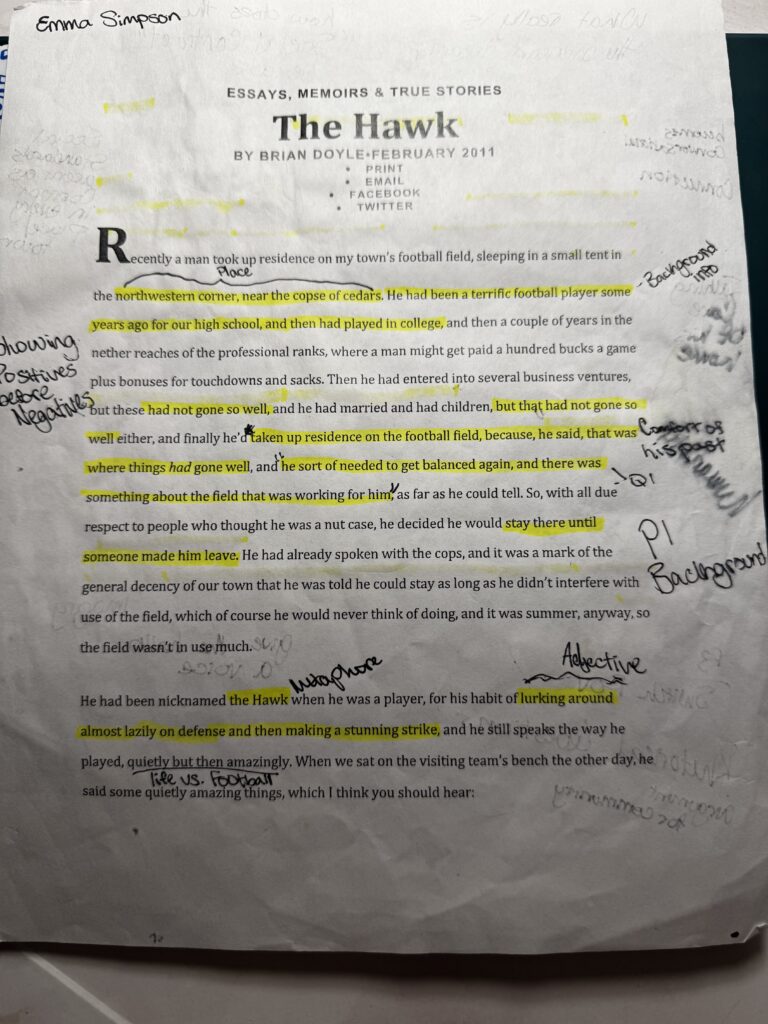
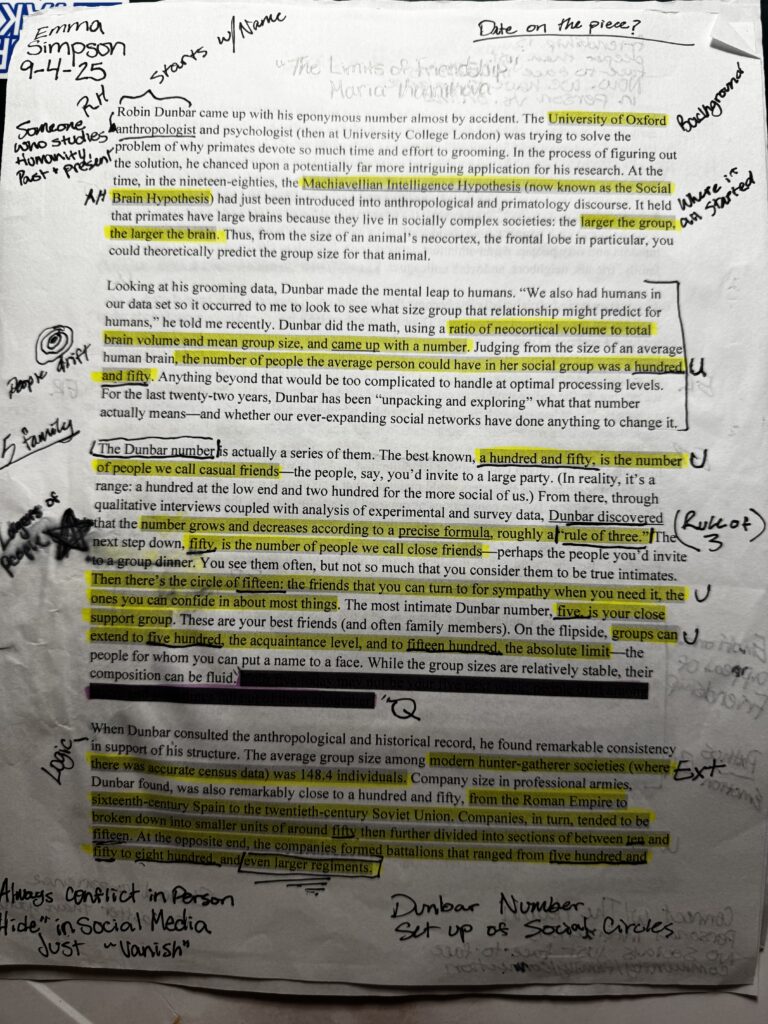
These images show my two different annotations for “The Hawk” and “The Limits of Friendship”. Although they look similar the words arent just random on Konnikovas essay they build understanding they dont just take up room on the page.
Previewing/skimming texts before I fully read them has also become a key part of my writing
process. By scanning headings, key terms, and the overall structure before just diving into the
full reading, I can get understanding and context which helps me as I fully read the text to
enhance my annotations. For example, knowing that “The Limits of Friendship” would include
studies with human beings helped me understand that this wasn’t just an “I believe this is right”
type of text it was one with scientific background. As a highschool student I brefily scimmed texts so I already had a basic understanding of previewing but I never really understood why It was so important that I do it. Now that I preview more it helps me realize there is more to a text than seems if you get deeper into the meaning of the words. Previewing helps you see the depth of the argument or subject before you even give it a full read.
My reading responses have grown from simple summaries to more critical and reflective
responses. In highschool I never really could connect on the larger themes and I would give a really basic and generalized summary on whatever the essay was about. But even in my first response which was “The Hawk”, I connected Doyle’s emotional and symbolic language to the larger themes of human connection and happiness, recognizing the essay/s reflective rather than argumentative tone. In contrast, my response to Konnikova involved synthesizing evidence about social media’s impact on friendships and relating it to emotional and physical touch, which I saw as a key to the essay’s argument. These responses show improved ability to engage with both content and form. Even from my first college reading I was able to contextualize more and retain more information to look at the bigger picture of what point the author was trying to get across.
Regarding source integration, I have begun to practice embedding quotes into my writings more
smoothly. In highschool I would tend to introduce a quote and analyze it but it wouldnt really fit in with the flow of the piece. But with Konnikova’s essay, for example, I can reference specific studies/statistics with explanation and analysis rather than simply dropping quotes into my text. I know how and where to propperly imput a quote and make it smooth. However, I recognize this is an area for continued growth. Sometimes my source integration still feels a bit forced and I want to continue blending sources into my texts while maintaining clarity in the topic. On September 5th, I completed an assignment on who Maria Konnikova is, with this we were also explaining some of her works and ideas. With one of her Ideas of the “Rule of Three” explained what it meant and integrated a quote. The paragraph I wrote was:
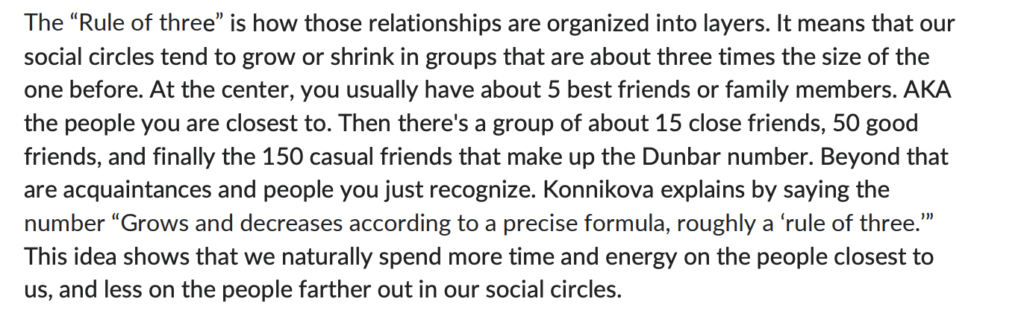
As you can see in the paragraph alone I was randomly imputting a quote and not really analyzing it. It didnt flow with the paragraph overall. Now I would go in approaching it differently. I would analyze and introduce the quote a bit more and tie it back to the overall idea im trying to get across. I also am better now at realizing that you never have to use the full quote, you can partially quote a sentence the author says. Partial quotting is still really strong and gets to the point that you want the readers to see.
In all, my practices with annotation, previewing, reading responses, and source integration have
become more purposeful and strategic. I have moved beyond marking text just to understand it
later to actually comprehending and I’m reading. Moving forward, I aim to develop my source
integration skills further, focusing on incorporation of evidence, and enhancing my analyzations
to deepen my understanding on the topics I am reading. I am nowhere near where I want to be in annotating, source integration, or previewing, it is something that I will continue to work hard on even if I think its “good enough”.
Q: What specific feedback did you receive and what comment(s) felt most helpful to your revision process? What did you notice, from reading a peers’ work, that might help inform your own writing? What were the biggest challenges you faced during your first peer review session, and how might you improve your experience for next time?
A: As we completed our first college-level peer review I felt stongly about the structure of the review and I also believe that my classmates all give good feedback. I believe -although it was our first run of peer review- that the information given back to me was clear and I could understand the point that my peer was trying to get across retaining my writing. With the comments my peer left it made me see the holes within my writing and helped me within the revision process. In addition, just reading my peers writings helped me see more holes in my writing. Whether it was missing information or filler words that just needed to be there, it helped me know where my writing needs to be cleaned up and improved on.
Some of the biggest challenges I faced while reading my peers work was not just reading their piece and right away thinking about their grammar and sentance structure, but thinking more about if every topic was covered and if their personal thoughts were imput. To improve my ecperience for next time im going to go into the peer review not just thinking of what I did and didnt do compared to them, but think more about if they hit every key point that they needed to make. Next time I do peer review I’m going to leave a little more annotations and maybe that will help me even more with my own writings.
